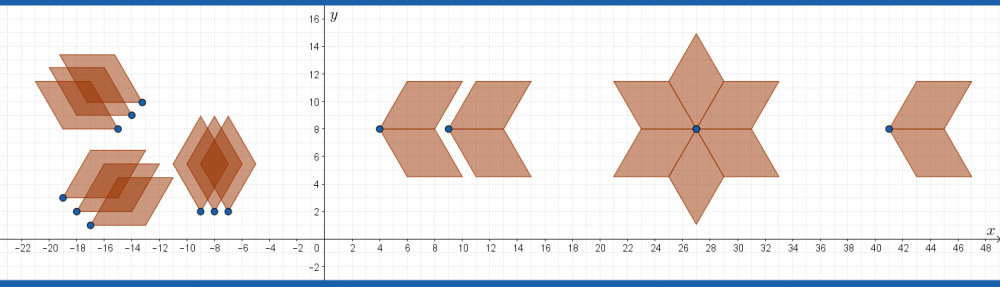
Using an exponent is a short hand form of writing repeated multiplication or repeated division.
The idea of short hand forms is not new: multiplication is a short hand form of writing repeated addition. For example:
![\[2+2+2+2+2+2+2+2=8\times2=16\]](https://tentotwelvemath.com/wp-content/ql-cache/quicklatex.com-a701c505bdb00964ecc4564e33d1be4d_l3.png "Rendered by QuickLaTeX.com")
Writing  is much easier than writing out the long addition.
As with any new notation in mathematics, we need to know what it means before we can use it well.
Here is an example of repeated multiplication:
![\[2\times2\times2\times2\times2\times2\times2\times2=256\]](https://tentotwelvemath.com/wp-content/ql-cache/quicklatex.com-2da9344de0d0dfc617facd8d95ff49f8_l3.png "Rendered by QuickLaTeX.com")
There are eight twos on the left hand side. This is how we use exponent notation for this repeated multiplication:
![\[2^8=256\]](https://tentotwelvemath.com/wp-content/ql-cache/quicklatex.com-e20b985dcd53637a54bdac27c3f69bfd_l3.png "Rendered by QuickLaTeX.com")
The other thing we know about multiplication is that we can multiply numbers in any order (commutativity property of real numbers).
![\[2\times3=3\times 2=6\]](https://tentotwelvemath.com/wp-content/ql-cache/quicklatex.com-9ec7bd77ca8d9a0210a59745b0def8ee_l3.png "Rendered by QuickLaTeX.com")
Now let’s use the commutativity property, and our new exponent notation to simplify this long expression:

Video from Math Antics
A Sequence: Repeated Multiplication; Repeated Division
Move the slider to the right to multiply by 2.
Move the slider left to divide by 2.
Notice the ‘middle number’ is 1.
An exponent records the number of times that the number 1 is multiplied or divided by the same number.
![\begin{align*}5^4&=1\times 5\times 5\times 5 \times 5 &= 625\\[10pt]5^3&=1\times 5\times 5\times 5&=125 \\[10pt]5^2&=1\times 5\times 5&=25\\[10pt]5^1&=1\times 5&=5\\[10pt]5^0&=1&=1\\[10pt]5^{-1}&=1\div 5&=\frac{1}{5} \\[10pt]5^{-2}&=1\div 5 \div 5 &=\frac{1}{25}\\[10pt]5^{-3}&=1\div 5\div 5\div 5&=\frac{1}{125} \end{align}](https://tentotwelvemath.com/wp-content/ql-cache/quicklatex.com-0c2c347fb2ab50e982c41370631928a1_l3.png "Rendered by QuickLaTeX.com")
You can type in any exponent of 5 into the calculator and arrive at any other exponent of 5 by either repeated multiplication by 5 or repeated division by 5. To multiply is to add to the exponent. To divide is to take from the exponent.
To learn about exponents, its useful to have some exponent facts memorized. The familiar values are square numbers, cube numbers, the first ten powers of 2 and the first 5 powers of 3.
Complete the table on Exponent Number Facts to Memorize to see how many exponent number facts you already have. The solution pdf is ENFM Solutions. Then test yourself with the following applet.
applet link
Notation
There are three words used for an exponent, they are used interchangeably. These are: exponent, power and index.

Why Exponents?
By learning about exponents we lay the foundation for several areas of learning. Here are four:
| Math | Description |
| Scientific Notation | A way of measuring exceedingly small values (the weight of a fruit fly) and exceedingly large values (the speed of light) using familiar units (kg, meters etc). |
| Growth and Decay | Exponential functions allow us to mathematically model how populations (eg of people, of bats, of bacteria) grow; and to model how materials like uranium decay over time. |
| Money | Savings accounts and loans, left to themselves, increase exponentially. To understand how this works, we need to understand exponents. |
| Prime Factors | Finding prime factors is a little like finding out the ingredients in a good soup. Prime factors help us see how numbers are related to each other.
For example, |
 ; and the number
  .
.Number Sense, compare powers of 2 and 4:
Compare the first five powers of 4 with the first ten powers of 2. Explain the pattern. Choose various values of  and
and  such that the following equation is true:
![\[2^m=4^n\]](https://tentotwelvemath.com/wp-content/ql-cache/quicklatex.com-788f77809fedc7d85b2b81121d695cd3_l3.png "Rendered by QuickLaTeX.com")
Number Sense, compare powers of 3 and 9:
Write three different equations, choosing values for and carefully such that the equation
![\[3^m=9^n\]](https://tentotwelvemath.com/wp-content/ql-cache/quicklatex.com-287d61fec9c2892cd93cbe215bd7895e_l3.png "Rendered by QuickLaTeX.com")
is true. Check your equations with a calculator.